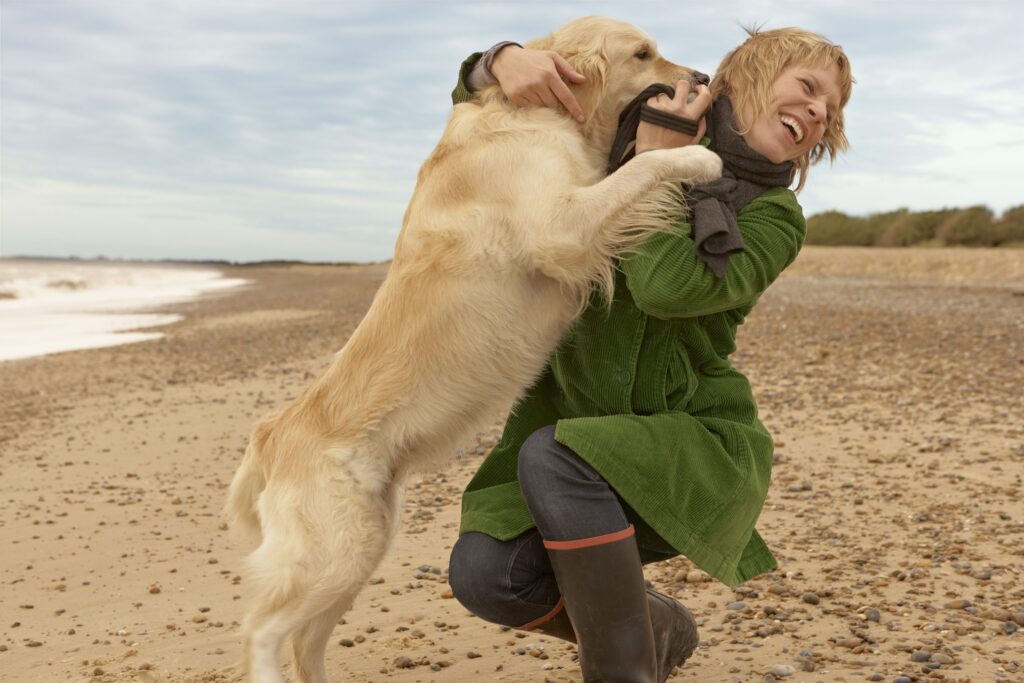
It’s One of the Most Common Complaints Dog Trainers Hear
The doorbell rings, your dog races toward the entryway, and before you have a chance to greet your visitors, they’re already apologizing for muddy paw prints on their clothes. If you’ve ever found yourself saying, “He’s just excited,” or “She always does this,” you’re certainly not alone. Jumping on guests is one of the most common behavior problems we see at Alaska Dog Works, and it’s one that frustrates even experienced dog owners. The good news is that most dogs aren’t jumping out of disrespect or to be difficult. They’re jumping because, from their perspective, it has worked incredibly well.
Understanding why dogs jump is the first step toward teaching them a better way to greet visitors to your home.
Your Dog Is Looking for Attention, Not Trying to Misbehave
When people meet one another, we usually shake hands, smile, or hug. Dogs have their own version of a greeting, and it’s much more direct. They naturally want to investigate faces, make close contact, and gather information through scent and body language. Since most people are much taller than dogs, jumping becomes the quickest way to reach the part of us they’re most interested in.
Puppies often learn this behavior without anyone realizing it. A small puppy that places its front paws on your legs is usually considered adorable. Family members bend down, pet the puppy, laugh, and offer affection. The puppy quickly learns an important lesson: putting my paws on people gets me attention. Months later, that same puppy weighs sixty pounds, but the behavior hasn’t changed. The only difference is that it is no longer cute.
The behavior didn’t suddenly become a problem because your dog grew up. It became a problem because the habit was unintentionally reinforced from the very beginning.
Dogs Repeat What Works
One of the most important principles in dog training is simple: behaviors that are rewarded tend to happen again.
Many owners assume they never reward jumping because they don’t like it. However, dogs don’t always see rewards the same way people do. If your dog jumps on a guest and receives petting, laughter, eye contact, conversation, or even a gentle push away, they’ve received attention. For a social dog, attention is often exactly what they were hoping for.
Imagine a guest walking through your front door. Your dog jumps up excitedly, and the guest responds, “Oh, I don’t mind,” while scratching the dog’s ears. Your dog has no reason to think they did anything wrong. In fact, they’ve just confirmed that jumping is an excellent strategy for getting someone to interact with them.
Even negative attention can strengthen the behavior. A dog that hears “No!” while making eye contact with an owner is still receiving engagement. To many dogs, that’s better than being ignored.
Mixed Messages Slow Down Learning
One reason jumping becomes such a persistent habit is because the rules often change depending on who’s visiting.
Perhaps you don’t allow jumping, but your children encourage it during playtime. Maybe your spouse enjoys enthusiastic greetings after work. Friends laugh and pet the dog while they’re standing on two legs. Grandparents say they don’t mind because they only visit occasionally.
Your dog isn’t trying to figure out who has different standards. They’re simply learning that jumping works often enough to keep trying.
Imagine trying to learn a new rule if it only applied half the time. You’d probably become confused about what was actually expected. Dogs experience the same uncertainty when different people respond differently to the same behavior.
Consistency isn’t important because dogs are stubborn. It’s important because consistency makes learning possible.
Excitement Makes Self-Control More Difficult
One reason jumping is so challenging to change is because it usually happens during moments of high emotion.
Your dog has been waiting all day for someone to come home. The door finally opens, and excitement takes over. At that moment, they’re not carefully thinking through every decision. They’re reacting emotionally to something they enjoy.
People experience similar moments. Think about seeing a close friend after several years apart or celebrating exciting news with family. Strong emotions naturally make thoughtful decision-making more difficult.
Dogs are no different.
That’s why trying to correct a dog after they’re already jumping often feels ineffective. Once excitement reaches that level, they’re far less capable of making thoughtful choices.
Successful training begins long before the front door opens.
Teach Your Dog What To Do Instead
One of the biggest mistakes people make is focusing entirely on stopping the unwanted behavior.
Dogs don’t learn particularly well when we only tell them what not to do.
They learn much more quickly when we clearly teach the behavior we want instead.
Perhaps you want your dog to sit politely whenever someone enters the house. Maybe you’d prefer they walk to a designated place bed and remain there until they’re invited to greet visitors. Some families choose to have their dog remain on leash during introductions until everyone has settled down.
There isn’t one perfect solution that works for every household.
What matters is giving your dog a clear, consistent job to perform instead of leaving them to invent one on their own.
The more frequently that new behavior is rewarded, the less interesting jumping becomes.
Practice Before It Really Matters
Many families unintentionally make holiday gatherings their dog’s first real test.
After months of little practice, relatives arrive from out of town, children are running through the house, and everyone hopes their dog will suddenly make perfect decisions in one of the most exciting environments they’ve experienced all year.
That’s a difficult expectation for any dog.
Instead, create opportunities to practice throughout the summer and fall. Invite neighbors over for coffee. Ask friends to stop by for a few minutes. Practice opening the front door while your dog remains on their place bed. Repeat these exercises often enough that greeting people calmly becomes routine rather than unusual.
By the time Thanksgiving or Christmas arrives, your dog won’t be learning a new behavior. They’ll simply be repeating one they’ve practiced many times before.
Good Management Helps Dogs Succeed
Training and management work together.
While your dog is learning better greeting habits, don’t hesitate to make the situation easier for everyone involved. Keeping your dog on a leash during introductions, asking them to settle on a designated mat before opening the door, or using baby gates to create space can prevent unwanted jumping rehearsals while the new behavior is still developing.
Good management isn’t admitting defeat.
It’s setting your dog up for success while they’re still learning.
Professional trainers use management every day because they understand that preventing mistakes is often easier than correcting them afterward.
A Calm Greeting Changes the Entire Experience
Imagine your next holiday gathering.
The doorbell rings. Your dog looks toward the entryway but walks to their place bed instead of charging the door. Your guests come inside without worrying about muddy clothes or being knocked off balance. After everyone has settled, your dog is invited to greet them calmly, receiving affection for keeping all four paws on the floor.
The difference may seem small, but it changes the atmosphere of your home.
Instead of beginning every visit with stress and apologies, everyone can simply enjoy being together.
That is what practical dog training is all about. It’s not about removing your dog’s personality or enthusiasm. It’s about helping them express that excitement in ways that make life easier for everyone.
How Alaska Dog Works Can Help
Teaching polite greetings is one of the first goals many families share with us because it’s a behavior that affects everyday life as well as special occasions. Whether you’re welcoming neighbors, hosting birthday parties, or preparing for Thanksgiving and Christmas, a dog that greets people calmly creates a more relaxed experience for everyone involved.
At Alaska Dog Works, we help families replace unwanted habits with practical behaviors that fit naturally into daily life. Through private lessons, board-and-train programs, and puppy training, we focus on giving dogs clear expectations while teaching owners how to reinforce those behaviors consistently at home.
The holidays are only a few months away, and there’s still plenty of time to teach your dog a better way to welcome visitors. The sooner you begin practicing, the more natural those calm greetings will feel when family and friends gather around your front door.
Schedule your training evaluation with Alaska Dog Works today, and let’s help your dog become the kind of host your guests will love to visit.
Where to Listen to Dog Works Radio

Dr. Robert Forto
is Alaska Dog Works’ training director.

Michele Forto
is the lead trainer for Alaska Dog Works.
Subscribe to the Dog Works Radio podcast, and check out The Pack newsletter, delivered straight to your inbox.
If you purchase through our links, Alaska Dog Works may earn a commission. Prices were accurate at the time of publication but may change.
We offer a FREE Strategy Call.
Click on the graphic to learn more



Read More

Australian Terrier: A Bright, Spirited Companion for Active Homes