The dog was friendly with everyone.
The dog sat calmly while people petted it at the school. The dog settled next to a resident at the facility. The family assumed the visits meant the dog was a service dog and could go anywhere. Then they took the dog into a store that does not allow pets. The skills that had held during a supervised visit did not create access. The family asked why the dog “works” in one place but isn’t welcome in another. The short answer was that therapy work and service work are different jobs with different standards.
That is the gap most people live with when the words get mixed up. That gap must be clear before anyone chooses a training path.
What’s the Difference
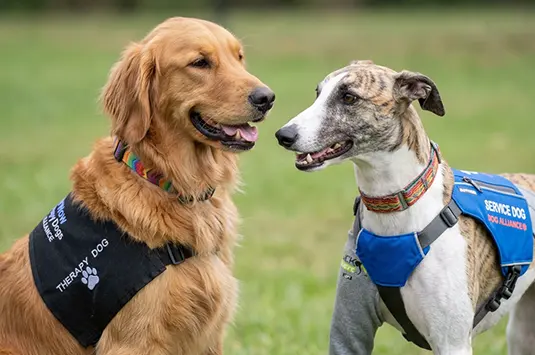
A service dog is a dog individually trained to perform specific tasks that mitigate a handler’s disability. The dog works for one person. The focus is on the handler. Public access under the Americans with Disabilities Act comes from that individual training and the tasks, not from a vest, a certificate, or a title. The dog is expected to remain workable around ordinary public distractions and perform tasks when needed. Not every dog is suitable. Evaluation comes first.
A therapy dog provides comfort and a calm presence to other people in places the team has been invited. Common settings include schools, hospitals, counseling offices, and similar places. The dog is social, steady, and well-mannered so it can be around unfamiliar people without a fight. Therapy work has its own evaluations and standards. It does not create the same public access rights as service dog work. A therapy dog is not a service dog, and a service dog is not automatically a therapy dog.
The official Alaska Dog Works command sheet still underpins both paths. LOOK, LET’S GO, STAY, COME, and BREAK give the dog a clear way to choose the handler and move through ordinary places. Those skills support either job. They do not turn one job into the other. Real-world reliability still applies: a behavior isn’t finished just because it works in a quiet room. It is finished when it holds where the work actually happens.
Why the Difference Matters in Practice
Mixing the two creates problems for the dog, the handler, and the public. A dog that is trained and evaluated for calm visits does not automatically have the right to enter a store, restaurant, or airport. A dog trained for specific tasks for one handler is not automatically ready to be the center of attention in a classroom or facility. The handler who needs task support for a disability is on the service path. The professional or volunteer who wants a calm, steady dog for invited work with other people is on the therapy path.
In Alaska, the ordinary places still test both. A therapy team needs the dog to stay steady in a heated office or a school hallway. A service team needs the foundation to hold in a store, on a ferry, or at an airport. The same cues and reliability standards support either goal. The evaluation and end use differ.
What Changes When the Paths Are Kept Clear
The household stops treating a friendly visit as public access. The dog is trained and evaluated for the actual job. The handler knows which screen to book and what “ready” looks like for that path. The same foundational skills improve everyday life either way.
It takes an honest look at what the dog and the household actually need. If the need is specific tasks for one person with a disability, the next step is a service evaluation. If the need is a calm, social dog for invited work with other people, the next step is a therapy evaluation by the professional team. Neither path is a vest or a certificate that creates the other job.
If you are sorting therapy dogs from service dogs, the next step is not assuming the visits create access. It is a clear look at which job you are actually asking the dog to do. Start with the information on how we evaluate and match dogs for service work, or book the appropriate consult if the fit still looks possible. Visit AlaskaDogWorks.com or call the office. The next right step is to start the honest assessment this week.
Related Articles
- AKC Canine Good Citizen: Why Every Dog Should Earn This Important Certification
- AKC Community Canine (CGCA): Taking Your Dog’s Training Beyond Basic Obedience
- How to Prepare Your Dog for Public Access Training
- Loose Leash Walking: Stop Pulling Once and For All
- Recall Training: Teaching a Reliable Come Command
- Leadership Stays: Building Calmness and Impulse Control
- Why Your Dog Doesn’t Listen Outside
- Understanding Dog Reactivity and How to Address It
- Rescue Dog Training: Building Confidence After Adoption
- The Importance of Socialization for Puppies
- Service Dog Training: What It Takes
- Therapy Dogs vs. Service Dogs: Understanding the Difference
- Common Dog Training Mistakes Owners Make
- Why Consistency Matters More Than Commands
- The Truth About Positive Reinforcement Dog Training
We offer a FREE Strategy Call.
Click on the graphic to learn more



Read More