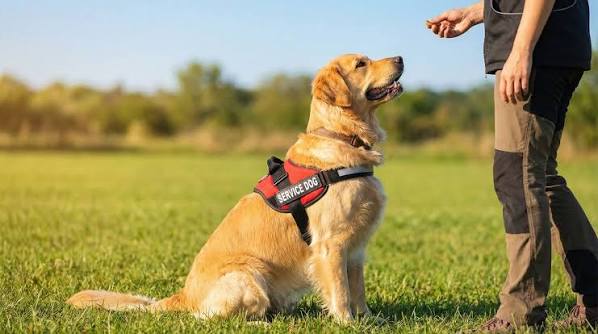
The family had a vest they bought online.
They had taught Sit, Down, and Come in the kitchen. They had walked the dog on a loose leash on the quiet road. They believed the dog was ready for service work. Then they took the dog into a store. A shopping cart rolled past. Another dog appeared. The handler needed the dog to perform a specific task under stress. The skills that had held in the kitchen did not hold. The family asked why the dog “knew” the commands but still couldn’t work. The short answer: a vest and basic obedience in one place don’t create a service dog.
That is the gap most people are living with when they start looking at service work. You must understand that gap before any training begins.
What Service Dog Training Requires
A service dog is a dog individually trained to perform specific tasks that mitigate a handler’s disability. The work is not a title, a certificate, or a piece of equipment. It is the combination of a suitable dog, clear foundation skills that hold in public, specific tasks that match the handler’s needs, and a partnership that continues after the formal sessions end.
Not every dog is suitable. Temperament, health, recovery under stress, and the ability to remain workable around people, other dogs, and ordinary public noise all matter. Evaluation comes first. A dog that is reactive, fearful, or unable to recover in ordinary places isn’t a candidate until those gaps close, and some dogs will never be the right fit. The honest next step is often an evaluation that says “not yet” or “this dog is not the right match.”
The foundation is the same real-world reliability standard used for every dog. A behavior isn’t finished just because it can be performed in a lesson. It is finished when it can be performed at home, in public, around distractions, around unfamiliar people and dogs, in new environments, and under moderate stress. For service work that standard is non-negotiable.
The official Alaska Dog Works command sheet is still the vocabulary. LOOK, LET’S GO, STAY, COME, and BREAK are the tools that let the dog choose the handler and move through ordinary places without a fight. Task training builds on that foundation, not instead of it.
Public access proves the foundation holds where life happens, stores, airports, ferries, sidewalks, and the ordinary places an Alaskan handler needs to go. It is practiced one variable at a time. You don’t assume it because the dog has a vest. Therapy dog work is a different path with different standards and is not the same as service dog work.
What the Process Looks Like in Practice
The process begins with a clear look at the handler’s needs and the dog’s suitability. An in-person evaluation shows what the dog can already do and where the gaps are. If the dog and the household are a fit, we build foundation skills until they hold outside the kitchen. We teach and proof specific tasks under the conditions the handler will actually face. The handler practices public access in real places. The handler learns how to maintain the skills after the formal training ends. Ongoing practice is part of the work because unused skills fade.
In Alaska, the environment adds variables: weather, wildlife, long distances, ferries, and small aircraft. A team that can hold the standard in those places has done the work. A team that has only practiced in a quiet room has not. The timeline is measured in months of consistent work, not weeks of lessons. Owner-trained teams often take longer because the handler is learning at the same time as the dog.
What Changes When the Work Is Done This Way
The handler stops treating a vest as the finish line. The dog has skills that hold when something interesting appears. The household has a clear picture of what “ready” looks like and an honest assessment of whether this dog can meet it. That same foundation supports everyday life, even if the dog isn’t ultimately a service dog candidate.
It takes consistency from the handler and the household. The environment will test the dog. That is not a failure. It is information. Go back one step, get the skill solid again, and return later.
If you are considering service dog training, the next step is not a vest and a few kitchen commands. It is a clear evaluation of the dog and a realistic look at what the work requires. Start with the information on how we evaluate and match dogs for service work, then book a Service Dog Consult if the fit still looks possible. Visit AlaskaDogWorks.com or call the office. The next right step is to start the honest assessment this week.
Related Articles
- AKC Canine Good Citizen: Why Every Dog Should Earn This Important Certification
- AKC Community Canine (CGCA): Taking Your Dog’s Training Beyond Basic Obedience
- How to Prepare Your Dog for Public Access Training
- Loose Leash Walking: Stop Pulling Once and For All
- Recall Training: Teaching a Reliable Come Command
- Leadership Stays: Building Calmness and Impulse Control
- Why Your Dog Doesn’t Listen Outside
- Understanding Dog Reactivity and How to Address It
- Rescue Dog Training: Building Confidence After Adoption
- The Importance of Socialization for Puppies
- Service Dog Training: What It Takes
- Therapy Dogs vs. Service Dogs: Understanding the Difference
- Common Dog Training Mistakes Owners Make
- Why Consistency Matters More Than Commands
- The Truth About Positive Reinforcement Dog Training
We offer a FREE Strategy Call.
Click on the graphic to learn more



Read More

Icelandic Sheepdog: A Loyal, Energetic Companion for Active Homes