The Answer Depends on the Dog, the Family, and the Life You Want to Live Together
One of the first questions we hear from new clients at Alaska Dog Works is surprisingly simple: “How much training does my dog actually need?” It’s an honest question, and it’s one that almost every dog owner asks at some point. They want to know whether a few lessons will solve the problem, if they should enroll in a board-and-train program, or whether their dog will require months of professional coaching.
Some are raising their first puppy and simply want to get things right from the beginning. Others have adopted an older dog with an unknown history and aren’t sure where to start. Regardless of the situation, they’re all looking for the same thing, a realistic understanding of what it takes to raise a dog they can confidently live with.
The truth is that there isn’t a single answer because there isn’t a single kind of dog or family. Every dog arrives with a different personality, different genetics, different life experiences, and different natural abilities. Every family has its own routines, expectations, schedules, and lifestyle.
A retired couple living in a quiet neighborhood has very different daily demands than a household with three young children, full-time careers, frequent travel, and a calendar packed with activities. The amount of training a dog needs depends less on an arbitrary number of lessons and much more on the life that dog is expected to navigate successfully.
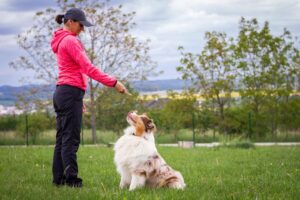
That may sound like an uncertain answer, but it’s actually good news. It means training can, and should, be designed around your family’s goals rather than forcing your family into a one-size-fits-all program. The purpose of professional training isn’t simply to teach commands. It’s to prepare your dog for the situations they’ll encounter every day, whether that’s relaxing quietly while you work from home, greeting holiday guests politely, traveling across the country, or hiking off the beaten path.
Basic Obedience Is Only the Beginning
Many owners think of dog training as a checklist. Once the dog learns to sit, stay, lie down, and come when called, they assume the job is finished. Those behaviors are certainly valuable, and they create an excellent foundation for future learning, but they’re only a small part of what makes a dog enjoyable to live with every day.
A truly well-trained dog knows far more than a handful of commands. They understand how to settle quietly while the family eats dinner. They wait politely before rushing through open doors. They greet visitors without jumping, walk comfortably on a loose leash, recover quickly from distractions, and remain calm when routines change unexpectedly. None of these skills develop automatically after completing an obedience class. They are life skills, and life skills are built through consistent practice in real-world situations.
This is one of the reasons professional trainers spend so much time asking about a family’s daily routine before recommending a training program. Teaching a formal sit is relatively straightforward. Teaching a dog to remain calm while children run through the house on Christmas morning or while relatives arrive carrying luggage requires a much broader approach. The goal isn’t simply obedience. The goal is helping the dog make good decisions in the environments where they actually live.
Puppies and Adult Dogs Have Different Needs
A common misconception is that puppies need more training than adult dogs simply because they have more to learn. In reality, puppies and adult dogs require different kinds of training. A puppy’s education focuses heavily on building positive habits before unwanted behaviors become deeply established. Socialization, confidence-building, household manners, crate training, leash introduction, and learning how to recover from new experiences all become priorities during the first year of life.
Adult dogs often arrive with a different set of challenges. Some have practiced unwanted behaviors for years, while others simply missed important learning opportunities when they were younger. An adult rescue dog may need help adjusting to family life, understanding household routines, or building confidence after experiencing significant changes. Another adult dog may already know several commands but struggle with distractions, unreliable recall, or excessive excitement around visitors.
Neither situation is better or worse. They simply require different training plans. Puppies benefit from prevention. Adult dogs often benefit from replacing established habits with more appropriate ones. In both cases, progress depends on consistency and thoughtful practice rather than the dog’s age alone.
Lifestyle Matters More Than Breed
Owners often ask whether certain breeds automatically require more training than others. While breed characteristics certainly influence energy levels, working instincts, and natural behaviors, we’ve found that lifestyle usually plays a much larger role in determining how much training is necessary.
Consider two Labrador Retrievers. One lives with an active family that hikes every weekend, regularly travels with their dog, and enjoys outdoor adventures throughout the year. The other lives with a retired couple whose primary goal is having a calm companion around the house and taking leisurely walks through the neighborhood. Although both dogs belong to the same breed, the expectations placed upon them are completely different.
The adventurous family will likely spend more time developing advanced recall, reliable leash manners, confidence in unfamiliar environments, and calm behavior around crowds. The retired couple may focus more heavily on greeting visitors politely, relaxing during quiet evenings, and maintaining good manners around the home. Neither family is training incorrectly. They’re simply preparing their dog for the life they actually live.
This is why professional training should never begin with assumptions based solely on breed. It begins by understanding the people on the other end of the leash.
Training Doesn’t End When the Lessons Do
Perhaps the biggest misunderstanding about professional dog training is believing that the training itself ends once the formal lessons are complete. Owners sometimes view lessons as they would a home repair project. Once the work is finished, they expect the results to remain permanent without much additional effort.
Dogs don’t learn that way.
Training is much closer to physical fitness than it is to fixing a broken appliance. You don’t exercise for six weeks and remain healthy for the rest of your life. You continue moving because healthy habits require regular practice. Dog training works much the same way. Once behaviors have been established, they need occasional reinforcement to remain reliable. Fortunately, that reinforcement usually becomes part of everyday life rather than feeling like formal homework.
Every walk reinforces leash manners. Every meal reinforces patience. Every visitor becomes another opportunity to practice calm greetings. Those moments require very little extra time because they happen naturally throughout the day. The difference is that well-trained families recognize those moments as opportunities instead of letting them pass unnoticed.
More Challenging Goals Require More Preparation
Not every dog owner has the same vision for what they hope to accomplish. Some simply want a companion who behaves politely around the house and enjoys neighborhood walks. Others dream of hiking national parks, traveling across the country in an RV, participating in canine sports, volunteering as a therapy dog team, or spending weekends camping in remote wilderness areas.
As those goals become more ambitious, the amount of preparation naturally increases.
A dog expected to remain reliable off leash around wildlife requires more advanced training than a dog who will always remain on leash during neighborhood walks. A therapy dog visiting hospitals needs greater emotional stability than a family pet whose primary responsibility is relaxing at home. A dog traveling frequently must learn to adapt confidently to changing environments, unfamiliar people, and unpredictable routines.
The important point is that none of these dogs receive “too much” training. They’re simply learning the skills required for the jobs their families have chosen for them. The amount of training always reflects the expectations placed upon the dog.
Quality Matters More Than Quantity
Owners sometimes become discouraged because they believe they don’t have enough time to train properly. They imagine that successful dogs are the result of hour-long practice sessions every evening or weekends devoted entirely to obedience work. While dedicated training sessions certainly have value, they are rarely the reason a dog becomes well-mannered.
Consistency always outweighs duration.
Five focused minutes of practice every day often accomplish more than one long session every other week. Dogs learn through repetition, and those repetitions happen naturally during everyday life. Waiting politely before going outside, settling while dinner is prepared, walking calmly to the mailbox, and coming when called across the backyard all contribute to the dog’s education. These moments accumulate quickly because they occur dozens of times each week without requiring a dramatic change to your schedule.
Families who understand this often feel enormous relief. They stop searching for large blocks of free time and begin recognizing the opportunities already built into their daily routine. Training becomes part of living with the dog instead of another task competing for attention.
Preparing Today for the Holidays Ahead
One reason we’re exploring this topic as part of our Christmas in July series is because many owners underestimate how much preparation is required before the holiday season arrives. They hope a few lessons in November will solve months, or even years, of unwanted habits before guests begin arriving at the front door.
Meaningful change takes time.
A dog that greets visitors politely during Thanksgiving has probably spent months practicing calm greetings throughout the year. A dog that settles quietly while presents are opened on Christmas morning has likely learned to relax during countless ordinary evenings at home. Those holiday successes aren’t created during the excitement of December. They’re built quietly during the ordinary routines of summer and fall.
By beginning now, families give themselves enough time to create habits instead of simply hoping for good behavior when it matters most. The result is a holiday season that’s more enjoyable for everyone, including the dog.
Training Is an Investment in the Life You’ll Share
At Alaska Dog Works, we don’t measure success by the number of lessons a family completes. We measure success by the confidence owners feel when they invite friends over, take their dog on vacation, enjoy a walk through the neighborhood, or simply relax together after a long day. Those everyday moments are the real reason training matters.
If you’re wondering how much training your dog actually needs, the better question may be this: What kind of life do you want to share together? Once you answer that question, the path forward becomes much clearer. Training isn’t about checking boxes or earning certificates. It’s about preparing your dog for the experiences, adventures, and ordinary moments that make life together so rewarding.
If you’re not sure what type of training is right for your dog, schedule a professional evaluation with Alaska Dog Works today. We’ll help you build a personalized training plan based on your dog’s personality, your family’s goals, and the life you want to enjoy together for years to come.
Where to Listen to Dog Works Radio

Dr. Robert Forto
is Alaska Dog Works’ training director.

Michele Forto
is the lead trainer for Alaska Dog Works.
Subscribe to the Dog Works Radio podcast, and check out The Pack newsletter, delivered straight to your inbox.
If you purchase through our links, Alaska Dog Works may earn a commission. Prices were accurate at the time of publication but may change.
We offer a FREE Strategy Call.
Click on the graphic to learn more



Read More