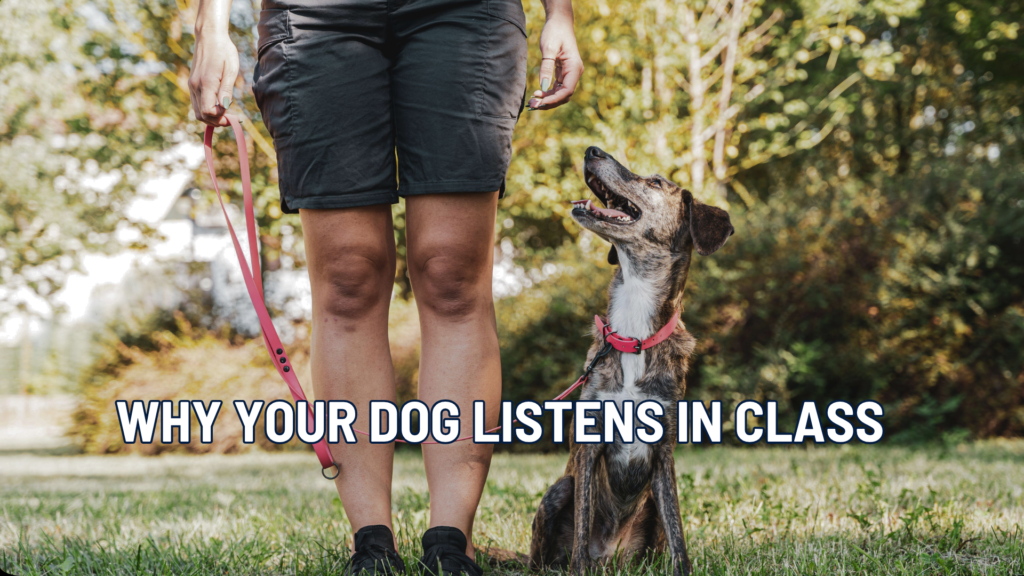
If you live in Anchorage, Wasilla, Palmer, or anywhere in the Mat-Su, you already know the gap. Your dog can look polished in a tidy training room and still fall apart at a trailhead, a busy sidewalk, or the front door when the kids get home. That is not a stubborn dog. That is training that never left the building.
Alaska Dog Works trains with families across Anchorage and the Valley who are done collecting “good in class” reports. We train you and the dog so the skills hold on real walks, real weather, and real weeks, not just when a trainer is standing there. If class went fine and home is still chaos, start here, then book a strategy call.
If your dog is a superstar in class and a different dog the second you hit the driveway, that is not a mystery. That is Alaska.
This is Michele with Alaska Dog Works. Most training is built for a rectangle: a clean floor, other dogs on leash, a trainer standing there, and a treat pouch that never runs out. That environment is useful. It is also not your life.
Your life is a muddy trailhead in Palmer. A bike path in Anchorage. A visitor at the door in Wasilla. A moose off the shoulder. Kids exploding out of the school bus. Ice underfoot. A snowmachine. A cabin door that should not become a launch pad.
If the plan only works when the trainer is watching, you do not have a trained dog. You have a trained session.
Here is what breaks. First, the dog learns the picture, not the skill. Sit on a mat in a building is one picture. Sit when a runner comes around a corner on a singletrack trail is a different job. Same word. Different world.
Second, the owner never gets trained hard enough. A lot of programs work the dog and hope you absorb it by standing nearby. Then you go home, the routine changes, and the dog votes for the old habit. Pulling. Barking. Charging the door. Selective hearing the moment a squirrel or a sled-dog team goes by.
Third, Alaska adds competing drive. Scent, wildlife, weather, space, other animals, other people. A recall that works in a parking lot can vanish when the dog’s brain says “moose” or “open trail.” That is not the dog being spiteful. That is a skill that was never proofed in the places you live.
So far, we have learned that your dog needs to learn the “skill” first, and then a dog trainer needs to “work” with the owner. Here is what we do instead?
We train both ends of the leash. The dog learns the behavior. You learn how to get it, keep it, and fix it when life gets messy. Fifteen minutes of sloppy practice at home will undo a beautiful hour in a classroom. Fifteen minutes of the rightpractice will lock it in.
We also train where the problem lives. Walks. Doors. Trails. Public. Winter gear. Real surfaces. If your dog only “listens” in a building, we do not call that done.
After 30-plus years and thousands of Alaska dogs, the pattern is the same. Families who win are not the ones who collect certificates. They are the ones who can take the dog into real life and still be in charge.
If you are done guessing, if class went fine and home is still chaos, that is exactly the conversation we have on a strategy call. We map what is breaking, what needs to change, and which program fits your family. Ascent, Base Camp, or Susitna. Not a lecture. A plan.
Go to alaskadogworks.com or call 206-752-DOGS. Tell us you heard this episode.
Reliable family dogs for Alaska owners who are done guessing. That is the work.