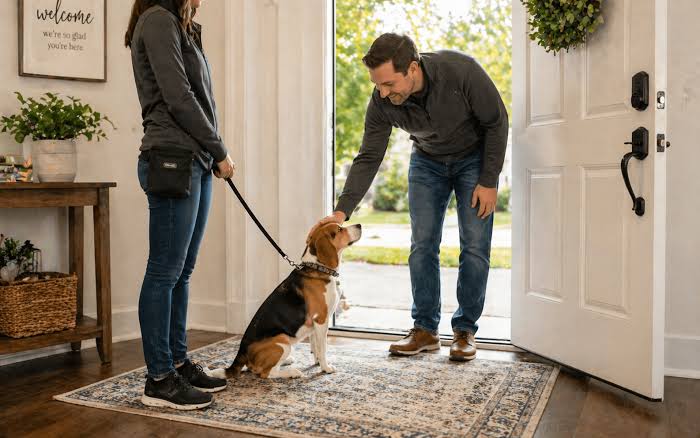
The house is about to fill up. Thanksgiving is Thursday, November 26, and between now and then someone who doesn’t live with your dog will come through your door. A nephew. A friend from town. Someone who hasn’t seen him since he was small and still thinks the jump is a compliment.
Your dog is not rude for being excited. He also doesn’t need to be in the middle of every hello. This week is for two decisions: how people get in the door. And where he goes when he has had enough of the party.
The knock at the door
Most of the trouble starts before anyone’s coat is off. The knock comes. He beats you to the door. Bodies pile up in the entry. Someone laughs, someone gets pushed back, and the visit is already a mess.
Do the hello in an order you can repeat. Dog settled, or behind a door, before you open up. Guest in. Coat off. Then the greeting, when the doorway is no longer a crowd. If he cannot be in that first minute without losing his head, he should not be in that first minute. That is not a punishment. That is how everybody, including him, gets a clean start.
Tell the other adult in the house the order before the truck pulls in. If one of you opens the door and the other says, “It’s fine, he’s just happy,” you don’t have a plan. You have two plans, and he will pick the louder one.
The guest who thinks jumping is love
You know this person. They crouch down, clap, say “it’s okay, I love dogs,” and put their face right in his. To them, the jump is affection. To your dog, it is the party he has been rehearsing.
Say it before they are in the house, not after he has already been paid for the jump. A plain sentence is enough. “Please don’t let him jump. We’ll say hello when his feet are on the floor.” If they cannot do that, he does not have to greet them. They can see him later, when the room is quieter, or not at all. Their feelings are not the training plan.
Kids are a different kind of guest. They move fast, squeal, hug necks, and don’t read a dog’s face the way you do. A dog who is easy with adults can be finished with children in about four minutes. Watch him.
If he leaves, let him leave. If he goes stiff, starts parking himself between the kids and the food, or can’t disengage, that is your cue to end his part of the visit. Do not wait for a snarl to make it obvious. And do not hand a child the job of managing him. That job is yours.
A place to leave the party
He needs a spot that is not the living room. A bedroom with the door shut. A crate he already likes, in a room away from the traffic. Water, something safe to chew, and nobody popping in to “just say hi.”
Set that spot up before people arrive. Use it while the house is still quiet, so it is not a brand-new penalty you invent when the noise starts. When he goes there in the middle of the visit, that is the plan working. A dog who can opt out is easier to live with than a dog who is trapped in the celebration until he makes a mistake.
If someone says he will feel left out, smile and leave him there anyway. Included is not the same thing as overwhelmed. You can bring him back out for a short, calm stretch. You do not owe the room a dog who stays until he falls apart.
Before they get out of the truck
Decide it tonight, while the house is yours. Who opens the door. Where he is for that first minute. What you will say to the guest who wants the jump. Which room is his when the kids get loud.
You do not need a new routine for the holiday. You need the same hello, and a door he can go behind. The rest of November, the meal and the days after, is on the Black November page. If you want first word on the Black Friday training offer before it opens to everyone on Friday, November 27, join the list. If guests are already on the calendar and you are already warning people before they walk in, book a strategy call. Don’t wait until the house is full to find out the door is the problem.
We offer a FREE Strategy Call.
Click on the graphic to learn more



Read More

The Mi-Ki: A Petite Companion with a Timeless, Elegant Spirit