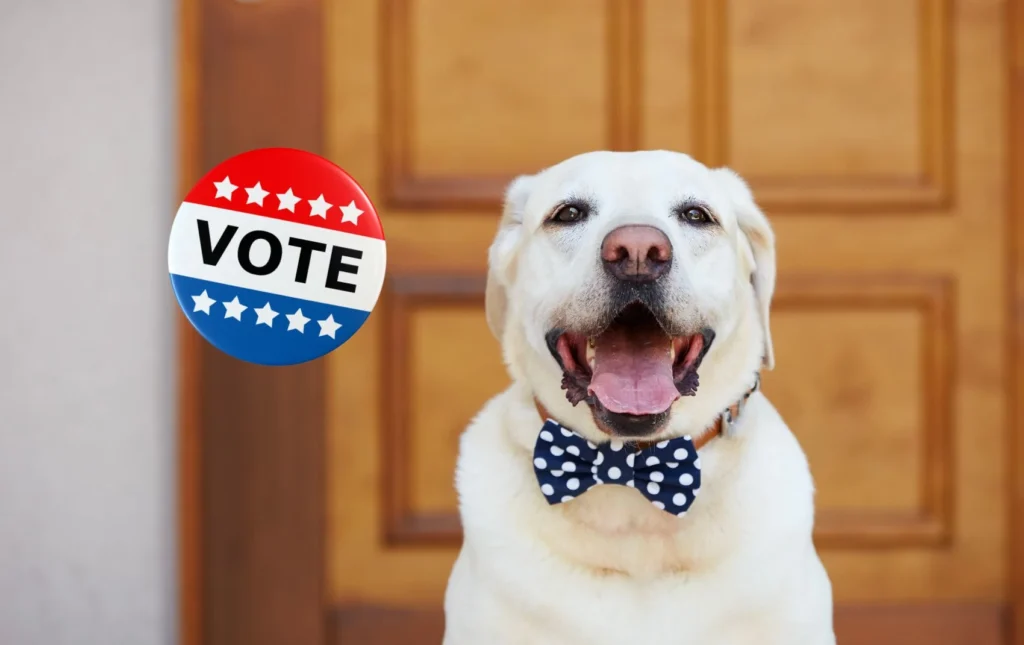
Election Day is Tuesday, November 3. Whether you’re reading this the night before or sitting in your truck with the heater running, the advice is the same: cast your ballot and leave your dog at home.
A polling place isn’t a spot for dog training or taking photos. It’s not like the feed store parking lot, where people expect dogs and often want to say hello. Instead, it’s usually a school, church, fire hall, or community building used just for the day, filled with strangers, wet boots, and a job that doesn’t involve your dog. Saying “He’s friendly” isn’t a plan. That’s how many dogs end up in trouble at the door.
People often see photos online of dogs at polling places and think it’s allowed everywhere. That’s not the case. Many of those photos are from different countries, years, or buildings. Your polling place is the one listed on your voter card, and it already has its own rules about animals. Election Day doesn’t change those rules.
Pets do not have the right to enter polling places
If your dog is a pet, there’s no federal rule that lets him join you in line. No Alaska law makes polling places dog-friendly for the day. Election officials and building owners can say no. Schools usually say no. Many churches say no. Most precinct chairs will say no as soon as a dog walks in on a leash.
Call your polling place to ask about their rules. Do this before you bring your dog, not when you’re already in line. If they say no, that’s it. Don’t try to change their mind with a cute bandana or a smile.
Don’t tie your dog to the railing while you go inside. November in the Valley is too cold and dark for that. Other dogs might pass by. A tied dog isn’t supervised, and poll workers aren’t there to watch your pet. Their job is to run the election, not hold your leash.
Don’t leave your dog in the car, even if you think it will be just ten minutes. Waiting in line often takes longer. A cold truck isn’t a safe place for your dog. If your only plan is to leave him in the car, you need a better plan.
Buying a vest online doesn’t make a dog a service animal
A service dog is not the same as a pet wearing a vest.
Under the Americans with Disabilities Act, a service animal is a dog individually trained to do work or perform a task for a person with a disability. Alaska’s own election guidance for voters with disabilities says service animals are permitted. A polling place has to let that dog come in with the person, even when the building’s everyday rule is no pets. That access belongs to the person. It is not a courtesy the precinct chair invented, and it is not something a vest can purchase.
Staff are not supposed to demand papers, a diagnosis, or a registration card. If it is not obvious what the dog is there to do, they may ask two questions: whether the dog is needed because of a disability, and what work or task the dog has been trained to perform. There is no official ADA registry. The sites that sell certificates and ID cards are selling paper. A piece of paper doesn’t train a dog or create access.
Under this definition, an emotional support animal does not count as a service dog. A therapy dog is not a service dog either. If your dog senses when you’re anxious but hasn’t been trained for a specific task, he isn’t a service dog just because you want him with you. If you’re unsure about the difference, start by learning how dogs are evaluated and matched for service work, then reach out for help. Don’t try to figure it out at the polling place on Election Day.
A true service dog must always be under the handler’s control. If the dog is out of control or not housebroken, staff can ask to have the dog removed. The person can still vote. Removing the dog is not the same as turning the voter away. A dog that barks at people, approaches strangers, or pulls its handler isn’t helping anyone, including the person who needs it.
If your dog is truly a service animal but can’t calmly handle a long line of strangers, that’s important to know. It’s not a reason to buy a new vest. It’s a reason to be honest about your partnership before you need it in public.
Where your dog should be on Election Day
The simple answer is best: your dog should stay home.
If someone else is home, they can stay with the dog while you go vote. You come back, and everything is fine. There’s no need to make it complicated.
If you live alone and your dog is used to his crate, a short trip out is just another errand. Before you leave, let him relieve himself, give him water, and use the crate he already knows. Don’t try a new setup the night before. If he’s never been left alone, Election Day isn’t the time to find out how he’ll react.
If your dog can’t be left alone and there’s no one to stay with him, adjust your voting plan instead of disrupting your dog’s routine. In Alaska, any registered voter can request an absentee ballot. Early and absentee in-person voting is also available before Election Day. Find forms, locations, and deadlines at elections.alaska.gov. If you already have a ballot at home, that’s the easiest option for your dog. Fill it out, follow the instructions, and send it in. Your dog can stay in the next room.
If you’re not sure you’re registered, check before you leave home. Don’t wait until you’re in the parking lot with your dog in the car.
What bringing a ‘friendly’ dog to the polls can cause
Polling places are full of things that attract or bother dogs: coats, boots, other dogs, restless kids, cafeteria smells, slippery floors, and people who may not want a dog near them.
Your dog doesn’t understand that voting is important. He just notices the noise and activity. If he behaves well only in quiet places, he won’t do well here. That’s not his fault, but the polling place isn’t the right spot to practice.
The important practice happens at home. Your dog should be able to sit or lie down while you get ready, stay quiet in a crate during errands, and respond to his name even when you’re leaving. If he can’t manage five calm minutes at home, he won’t do better in a busy polling place.
Don’t take photos in line. The polling place isn’t for photo shoots, and other people’s ballots aren’t for social media. Your dog’s outfit isn’t the main story. The real story is that you voted and your dog was safe at home.
Planning for Election Day morning
Make your plan tonight: decide who is voting, when, and where your dog will be during that time. Let others in the house know. If your dog will be in a crate, set it up ahead of time. If you’re dropping off a ballot, put the envelope by the door so you’re not searching for it while your dog thinks it’s time for an outing.
Go vote, then come home. Your dog will still be happy to see you. He doesn’t need to be at the polling place for that.
The rest of November is the house after the ballot: guests, the meal, and a dog who can be in a room without running it. That month lives on the Black November page. If you want first word on the Black Friday training offer, join the Alaska Dog Works list. If the real problem is that this dog cannot be left, cannot settle, or cannot be trusted around strangers, book a strategy call. Do not wait for a holiday to prove it.
Where to Listen to Dog Works Radio

Dr. Robert Forto
is Alaska Dog Works’ training director.

Michele Forto
is the lead trainer for Alaska Dog Works.
Subscribe to the Dog Works Radio podcast, and check out The Pack newsletter, delivered straight to your inbox.
If you purchase through our links, Alaska Dog Works may earn a commission. Prices were accurate at the time of publication but may change.
We offer a FREE Strategy Call.
Click on the graphic to learn more



Read More


4 Things to Remember when Training Your New Christmas Puppy