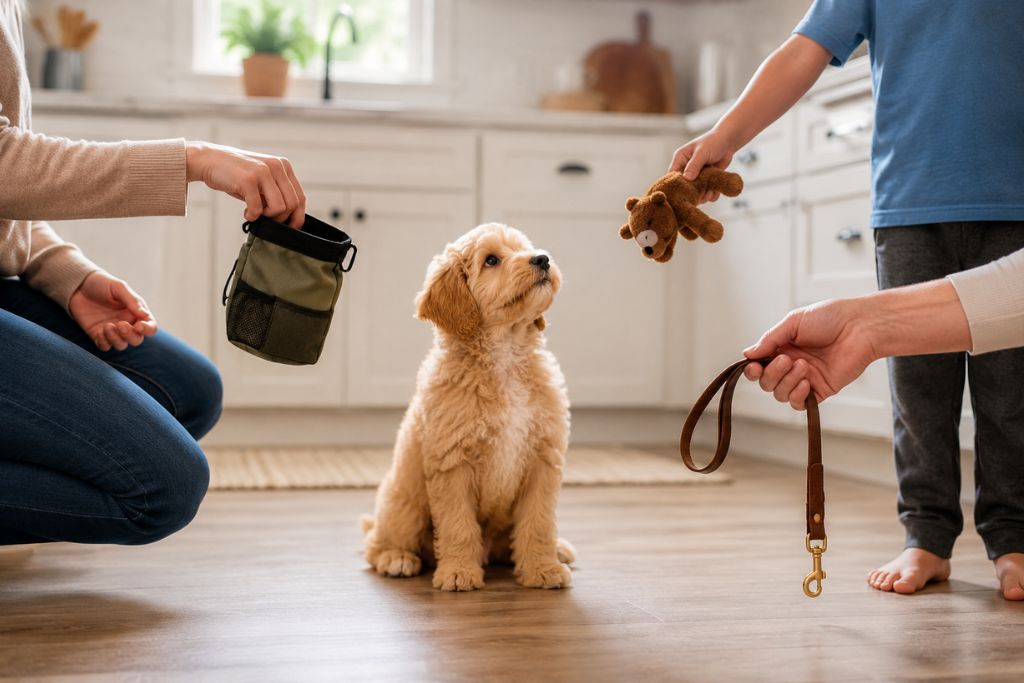
The puppy sat when one person asked and bounced up when another person walked in the room.
The family had agreed on the cues before the puppy came home. LOOK, SIT, STAY, COME, LET’S GO, and BREAK were written on the command sheet and stuck to the fridge. One adult followed through every time. The kids thought the jumping was cute and rewarded it with attention.
Another adult opened the door the moment the puppy looked at it. Within a week, the puppy had learned that the rules depended on who was standing there. The family asked why the puppy “knew” the words at training and ignored them at home. The short answer: the household hadn’t yet decided that everyone would deliver the same message.
That is the gap most families hit in the first month. And it is the gap that decides whether the skills become real-world reliability or stay kitchen tricks.
Why the Whole Household Has to Be in the Training
A puppy does not learn one set of rules for the main handler and a different set for everyone else. The puppy learns what is paid and what is ignored from every person it meets in the house. If one person requires a Sit before the door opens and another person opens the door the moment the puppy looks at it, the puppy learns that the Sit is optional.
If one person rewards a calm greeting and another person pets the puppy while it is jumping, the puppy learns that jumping works with some people. The dog follows the most predictable person, not the person who loves it the most. When every person in the house is that predictable person, the skills travel.
As for commands: LOOK asks the puppy to choose the handler when something new appears. LET’S GO is the walking position. STAY is the stay until released. COME is the recall. BREAK is the release. Those words mean the same thing every time, from every person.
Real-world reliability still applies: a behavior is not finished because it can be performed in the living room. It is finished when it can be performed at the doorway, in the yard, on the quiet road, around ordinary household noise, and under moderate stress. Consistency from the whole household is what lets the skill leave the kitchen.
Family Agreements Before the First Week Ends
Sit down before the puppy has practiced the wrong picture for long. Decide, as a household, which behaviors will be paid and which will not. Who handles the morning potty break? Who practices the short sessions after meals? Which official cues will be used and which words will not be invented?
How will the puppy be greeted at the door? Whether the puppy is allowed on the couch. What happens when the puppy jumps, and what happens when it does not. Write the agreements down. The list does not have to be long. It has to be the same for everyone.
In Alaska, the ordinary places still matter. The doorway when a raven is in the yard. The quiet road before the trailhead. The entry when the kids come home from school. A household that has already agreed on the cue and the follow-through for those moments is practicing the right picture. A household that is still negotiating while the puppy is learning is practicing the wrong one.
How Kids Can Participate Without Undoing the Work
Young children can help when an adult is present, and the activity is short and clear. A child can practice LOOK with the puppy at a distance; the puppy can still choose. A child can ask for a Sit and deliver the reward after the response. A child can help with the routine of going to the potty spot and returning.
The adult watches the puppy’s body language and ends the session the moment the puppy looks uncertain, or the child gets too loud. The child does not invent new words. The child does not open the door because the puppy looks at it. The child does not pet the puppy while it is jumping. Those boundaries keep the training intact while the child learns to be part of the team.
What Changes When the Household Is Aligned
The puppy stops checking which person is present before deciding whether to respond. The same cues start to hold at the doorway and on the quiet road. The household gains one set of rules instead of several competing ones. The same foundation that supports Canine Good Citizen skills later is being built now, because the follow-through is the same every day.
It takes attention to the small moments. The puppy will still test the rule when something is interesting. That is not a failure. It is information. Go back one step, get the follow-through solid again, and return later. Over days and weeks, the puppy learns that the word means the same thing every time and that responding pays, no matter who is standing there.
If the puppy in your house already has different rules depending on who is home, the next step is not a new cue or a longer session. It is a household agreement on the official words and the same follow-through from every person.
Ready to map the places the rules still change? Book a Strategy Call, and we will look at the gaps and the next right step. Visit AlaskaDogWorks.com or call the office. The next right step is the one that gets the household aligned this week.
We offer a FREE Strategy Call.
Click on the graphic to learn more


Read More