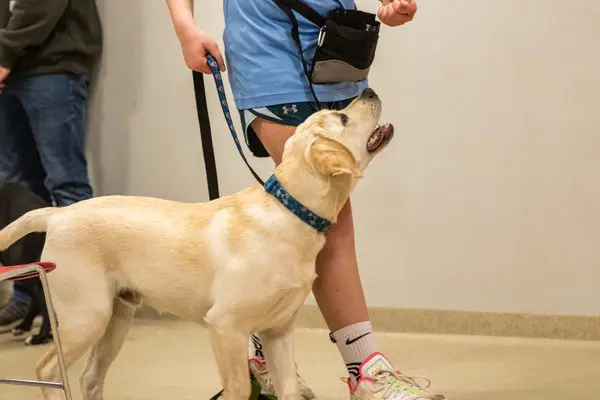
The dog was quiet in the car.
The dog walked into the house and froze at the doorway. The family coaxed. The dog moved a few feet and froze again. Outside in the yard the dog startled at a raven and did not recover for several minutes. The family asked whether the dog was “broken” or whether the past had made training impossible. The short answer was that the dog was in a new environment with unfinished skills. Confidence is built by making the next step clear and successful, not by waiting for the past to disappear.
That is the gap most families are living with after an adoption. And it is the gap that has to close before the dog can settle into ordinary life.
What Confidence Looks Like After Adoption
Confidence is not the absence of hesitation. It is the dog’s ability to recover and respond to a clear cue in a new place. A rescue may arrive with limited experience around people, other dogs, household noise, leashes, or doorways. The dog may also arrive with a history of inconsistent rules. The result is the same: the dog does not yet know what the new house expects, so the dog waits, freezes, or tries the response that has worked before.
Not every pause is trauma. Many pauses are simply unfinished learning. The dog has not practiced the skills in this house, in this yard, with these people. The official Alaska Dog Works command sheet is still the vocabulary. LOOK asks the dog to choose the handler. STAY and KENNEL UP give the dog a place to settle. COME is the recall. LET’S GO is the walking position. BREAK is the release. The dog does not need a special “rescue” set of words. The dog needs the same words practiced where the dog can succeed.
Real-world reliability still applies. A behavior is not finished because it can be performed in a quiet room. It is finished when it can be performed at home, in public, around distractions, around unfamiliar people and dogs, in new environments, and under moderate stress. For a new rescue the first environment is the new house and yard. That is where the work starts.
How to Build the Picture Without Overwhelm
Start where the dog can succeed and add one variable at a time. Practice short sessions, five to ten minutes, of LOOK, SIT, or a short STAY in the kitchen or living room where the dog is already settled. Then practice the same skills near the doorway. Then in the yard with mild distractions. Then on a short walk on a quiet road. Five clean repetitions teach more than a long outing where the dog practices freezing or overreacting.
Protect the cue. Say it once. If the dog does not respond, help the dog succeed or go back one step. Do not repeat the word until the dog has succeeded. Reward the response the dog actually wants. Use management while the skills are being built: a crate or KENNEL UP for rest, a long line for safe outdoor practice, limited exposure to triggers until the dog can respond at a workable distance. Consistency from every person in the house is the multiplier. If one person releases the dog the moment it looks uncertain and another person follows through, the dog learns that uncertainty ends the exercise.
In Alaska the ordinary places still matter. The doorway of the new house. The yard when a raven flies. The quiet road before the trailhead. The driveway when another dog appears in the distance. A dog that can recover and respond in those places is building the confidence that lets the family take the next step. A dog that is flooded with new experiences before the skills hold is practicing the wrong picture.
What Changes When Confidence Builds
The dog stops treating every new thing as a reason to freeze or explode. The household gains a clear set of cues and a routine the dog can predict. The same skills that appear in the Canine Good Citizen standard become reachable because the foundation is being built in the places the dog actually lives. The process is the same as with any other dog: clear criteria, predictable consequences, and consistency.
It takes time. The dog will still hesitate when something is new. That is not a failure. It is information. Go back one step, get the skill solid again, and return later. Over days and weeks the dog learns that the house has a clear plan and that responding to the cues pays.
If the new rescue in your house freezes at the doorway or overreacts in the yard, the next step is not a busier place or a different story about the past. It is the same cues practiced where the dog can still succeed, with the same follow-through from every person in the house.
Ready to map the first skills and the places they still break? Book a Strategy Call and we will look at the specific gaps and the next right step. Visit AlaskaDogWorks.com.
The next right step is the one that gets the work started this week.
Related Articles
- AKC Canine Good Citizen: Why Every Dog Should Earn This Important Certification
- AKC Community Canine (CGCA): Taking Your Dog’s Training Beyond Basic Obedience
- How to Prepare Your Dog for Public Access Training
- Loose Leash Walking: Stop Pulling Once and For All
- Recall Training: Teaching a Reliable Come Command
- Leadership Stays: Building Calmness and Impulse Control
- Why Your Dog Doesn’t Listen Outside
- Understanding Dog Reactivity and How to Address It
- Rescue Dog Training: Building Confidence After Adoption
- The Importance of Socialization for Puppies
- Service Dog Training: What It Takes
- Therapy Dogs vs. Service Dogs: Understanding the Difference
- Common Dog Training Mistakes Owners Make
- Why Consistency Matters More Than Commands
- The Truth About Positive Reinforcement Dog Training
We offer a FREE Strategy Call.
Click on the graphic to learn more


Read More

Korean Sapsali Shaggy Dog: The Loyal Guardian with a Rich Heritage