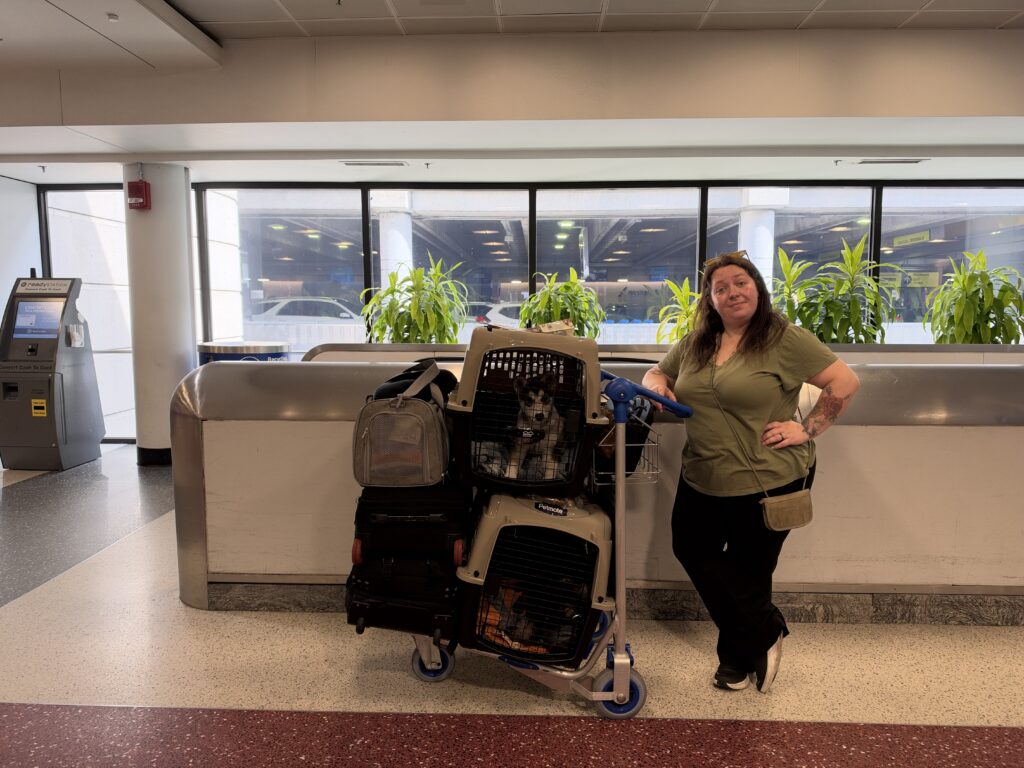
Last week Nicole and I took a flight from Anchorage to Boston, rented a car and drove through New Hampshire and Maine to pick up two new puppies: Skoll, a Seppala Siberian for me, and Durin, a German Shepherd for Nicole. We then reversed our journey, bringing both puppies back in Alaska Airlines’ cargo hold. Over the weekend, we made trips to tourist spots (lighthouses, a lobster roll in Portland, the Stephen King house in Bangor, and Old Orchard Beach) while also handling the practicalities of traveling with young dogs. Here’s what we found out, and the steps that made a difference.
Flights: Empty Crate Out, Two Puppies Home
We traveled from Anchorage to Boston on Wednesday night with one empty crate in our checked luggage, and because we had Atmos Rewards credit cards, there was no fee. We got the second crate from the breeder.
When they returned, the two puppies traveled in Alaska Airlines’ climate-controlled baggage compartment. The charge was $200 for each puppy. Alaska is one of the few U.S. carriers that still allow pets to be transported this way if the owner is on the same flight (total weight of the pet and its kennel up to 150 lb). A health certificate issued within 10 days of travel is required, along with a rabies certificate for travel to or from Alaska. Dogs under about three months of age are generally exempt from the rabies certificate requirement, but it’s best to check with your veterinarian and the airline.
Actionable tips:
- Check directly with the airline before booking about current pet policies, fees, breed restrictions, and temperature embargoes. Policies can change, and not all flights or aircraft will accept pets in the hold.
- When using an outbound empty crate, treat it as regular checked luggage and use any credit card or status benefits that waive the baggage fee.
- If the puppies are too big to fit in the cabin, you should book the return flight with an airline that allows pets in the baggage compartment. You can expect to pay $200 each way with Alaska (the fare is lower if the trip includes only pure Alaska or Hawaii destinations or if it involves military travel).
- Make sure you complete all required documents upon arrival: a health certificate (obtained within 10 days), rabies records if required, and proof that the crate meets the size requirements (the dog must be able to stand, turn around, and lie down comfortably).
Rental Cars: Crates Keep Things Straightforward
We rented a standard SUV from Enterprise, a company whose policy allows pets as long as they stay in crates and the vehicle is returned free of hair, odor, or damage. We kept both puppies in their crates throughout the rental, so we complied with the conditions and didn’t have to pay the cleaning fee.
Actionable tips:
- Select a vehicle large enough to carry the crates and equipment; an SUV worked well for two crates and our luggage.
- When you pick up the car, check the policy for that location, since the corporate policy is generally the same but local practices may differ.
- Place seat covers or absorbent pads under the crates, and use a handheld vacuum or lint roller. Return the car exactly as you found it.
- It is never acceptable to leave dogs alone in a hot car. When we stopped in Salem that day, the outdoor temperature was only around 50°F. We gave the puppies a good exercise both before and after the stop, made sure they had access to water, and kept our break short. Use your judgment and take local conditions into account.
Hotels: Verify Pet Policies Yourself
On our first night we booked a room at the Hampton Inn in Exeter, New Hampshire; we went back there on Sunday night since we already knew that they accepted pets (the fee being $55, which covered up to two dogs); on Friday night we stayed at the Best Western in Presque Isle.
Saturday night was the only exception; although the property was advertised as pet-friendly on a third-party website, it had a “no pets” sign when we arrived. The receptionist couldn’t cancel or refund a reservation made through that third-party site, but she agreed to let us stay on the condition that we were clearly warned not to let the puppy run down the hallways. On the second night at the Hampton Inn, the noise level was higher than the first night, surely puppies will be mischievous, but the known pet policy kept the situation under control.
Actionable tips:
- To confirm the hotel’s current pet policy, the fee, weight limits, and any restrictions, call them directly before booking; online information (particularly from third-party sites) is not always correct.
- Favor properties you’ve used before or those that clearly set out pet-friendly terms and fees in writing.
- With third-party bookings, there is usually little flexibility on cancellation or refunds. Have a backup plan.
- If the puppies are young and noisy, ask about quiet rooms or ground-floor rooms. Also bring some familiar bedding, white noise, and a plan for late-night potty breaks.
- Expect to pay a pet fee, and at many mid-priced hotels it typically ranges from $50 to $75 for one or two dogs.
Airport Check-In with Dogs in Cargo
On Tuesday, we set off from Exeter with plenty of time to spare, stopped to pick up the dog food needed for the journey, and gave the puppies one final walk at the Massachusetts Visitor Center. We reached Boston Logan early, since the Alaska Airlines guest services for the afternoon flights began at 1:45 p.m.
It took more than an hour to check both dogs. We needed the health certificates, the food, the zip ties to secure the crates of the correct size, and all the other necessary items. We then waited until exactly two hours and thirty minutes before leaving for the TSA to inspect the puppies. We got to the gate with about two hours left. Once we had boarded, Alaska gave us the “Your pet is on board” message. The flight back had a two-hour layover in Portland.
Actionable tips:
- Build in extra time when making your airport timetable, since checking in pets as cargo is a slow process. Arrive at the ticket counter well before the airline’s stated cutoff time, and be prepared for the TSA counter (in our case, 2.5 hours in advance).
- Make sure you have a full checklist, including a health certificate (which must be obtained within 10 days), rabies records if they are required, food for the journey, water, absorbent bedding, zip ties or crate fasteners that are approved by the airline, and a crate that conforms to the required size and ventilation standards.
- Check the exact guest services opening time and the pet check-in cutoff time for the airport and flight that you have in mind.
- When the pets have been accepted, you will usually get a confirmation (for example, Alaska’s ‘Your pet is on board’ message). Make sure to keep that information.
- For connecting flights, be ready to collect and recheck your pets if the airlines don’t automatically transfer them. Generally, Alaska does not transfer pets from the baggage hold to other carriers.
Extra Road Tips for Young Puppies
Give puppies plenty of exercise, take them out frequently, and provide mental stimulation. We made sure to mix tourist visits with plenty of walking and playing. It was a pleasure to film them at Old Orchard Beach wearing my new Ray-Ban Meta glasses, but our main concern was keeping the puppies calm, fed, and comfortable in their crates during car journeys and hotel stays.
Quick checklist for the trip:
- The health certificates were timed correctly and printed copies were available.
- Crates must satisfy the airline’s size requirements and be secured using zip ties.
- The food that the airline will accept for travel, together with water bowls.
- We plan potty breaks and exercise at each stop.
- Confirm the pet policies for each hotel and the rental car.
- We allow extra time at the beginning and end of the flight for check-in and TSA.
- Having realistic expectations regarding the level of noise and energy the puppies will exhibit when they are with you.
You can travel with new puppies if you prepare adequately: an airline that permits pets in the luggage area, hotels whose policies you have checked, a rental car that allows dogs to be crated, and a practical timetable that turns a several-day pickup into a successful journey back home. Skoll and Durin are getting used to life in Alaska now, and the road experience will shape how we plan future trips with them.
Remember, policies and fees can change, so continually verify the latest requirements with your airline, veterinarian, rental company, and hotels before you travel. Safe travels, and welcome home to the new team members.
We plan to do A LOT of updates on our social media channels (Facebook, Instagram)and we are going to compare and contrast the training of two entriely different breeds using our proven dog training methods. It should be fun.
Where to Listen to Dog Works Radio

Dr. Robert Forto
is Alaska Dog Works’ training director.

Michele Forto
is the lead trainer for Alaska Dog Works.
Subscribe to the Dog Works Radio podcast, and check out The Pack newsletter, delivered straight to your inbox.
If you purchase through our links, Alaska Dog Works may earn a commission. Prices were accurate at the time of publication but may change.
We offer a FREE Strategy Call.
Click on the graphic to learn more



Read More
Outward Hound Fun Feeder Dog Bowl Slow Feeder Stop Bloat for Dogs