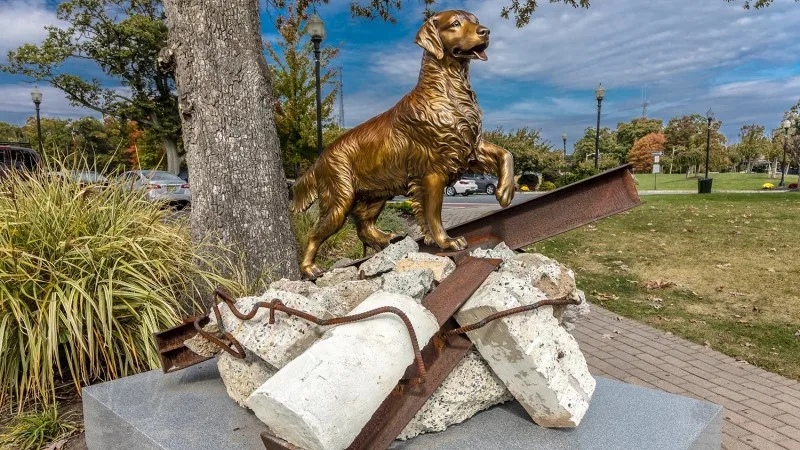
Twenty-five years later, most of us remember the skyline, the names, and the first responders who ran toward the buildings. Fewer people pause for the dogs who walked in with them.
On September 11, 2001, and in the days that followed, roughly 300 search-and-rescue dogs worked the World Trade Center, the Pentagon, and Shanksville. Police K-9s, FEMA task-force dogs, and a smaller number of therapy dogs stood in heat, steel, and dust. Guide dogs led handlers down smoke-filled stairs. One working dog never came home.
This is their story, the work, the names worth saying, and what those teams left behind.
What the Dogs Were Asked to Do
Search dogs do not watch the news. They work a pattern. They indicate. They wait for a handler to believe them.
At Ground Zero, the ground was not ground. It was twisted metal, pulverized concrete, and heat that burned paw pads through booties. Shifts ran long. Eyes were rinsed. Dogs were washed off again and again. Some collapsed from smoke and exhaustion and still went back.
Most teams arrived trained for wilderness or disaster work, not for a collapsed city. They adapted because the people beside them adapted.
When the hope of live-find faded, many of the same dogs shifted to recovery. That is a different job in a dog’s body. Live-find dogs are wired for the reward of a person under the rubble. Recovery work is quieter and heavier. It asked something extra of dogs and handlers both.
Therapy dogs were not there to find anyone. They were there so a firefighter, a medic, or a volunteer could put a hand on fur and keep going.
Names Worth Saying
Three hundred dogs will not fit in one article. A few stories stand for the rest.
Sirius
Sirius was a yellow Labrador with the Port Authority Police, trained to detect explosives. On the morning of the attacks, his handler, Lieutenant David Lim, kenneled him in the South Tower complex and ran toward the emergency. Sirius did not make it out. He is the only working dog known to have died in the attacks. His remains were recovered months later, with an honor guard present.
Roselle and Salty
These were guide dogs, not search dogs. Roselle led Michael Hingson down from the North Tower. Salty led Omar Rivera out as well. They did the job they were trained for in a smoke-filled stairwell full of fear. That was enough. They did not re-enter the towers to rescue crowds, that viral version is not the true one.
Apollo
Apollo, an NYPD German Shepherd, was among the first K-9s on the pile. He worked through debris and heat that would have ended most dogs’ day. He later received the Dickin Medal on behalf of the search-and-rescue dogs of 9/11.
Trakr
Trakr, a German Shepherd with the Halifax Regional Police, is remembered for helping locate Genelle Guzman-McMillan, the last survivor pulled alive from the World Trade Center wreckage, more than a day after the towers fell. After that find, he collapsed from smoke and fatigue.
Bretagne
Bretagne (pronounced Brittany), a Golden Retriever with Texas Task Force 1, worked Ground Zero for days on almost no sleep, then went on to hurricanes for years after. When she died in 2016 at sixteen, she was believed to be the last of the 9/11 search dogs still living.
There were many others: Sage at the Pentagon, Jake on the pile, comfort dogs who stood next to recovery workers when the search had become something else. That is also work.
What the Health Studies Found, and What They Did Not
After 9/11, veterinarians and researchers followed those teams for years. The Penn Vet Working Dog Center, among others, exists in part because people stood in that dust and decided the dogs deserved a longer scientific memory than a news cycle.
The careful version of the science is this: when researchers compared deployed search dogs with similar search dogs who were not sent to the sites, they did not find a clear, statistically proven surge in cancer or chronic lung disease. Many of the 9/11 dogs lived a typical working-dog lifespan. Degenerative disease and cancer appeared in both groups.
That does not make the work light. Paws burned. Dogs exhausted themselves. Some handlers watched a partner fade and wondered what the pile had taken. We can honor the study and still tell the truth about the cost.
Human responders often spent months on the site. Most dogs were deployed for days, not months. Dogs also have nasal anatomy that may have trapped more large particles before they reached deep lung tissue. Those are explanations, not a claim that the air was harmless.
The Legacy Those Teams Left
September 11 changed how the public saw working dogs. Training pipelines grew. Disaster canine programs expanded. Long-term health monitoring became part of the conversation instead of an afterthought.
The partnership itself is the other legacy. A trained dog and a trusted handler are not a novelty. They are a rescue system. That was true on the pile. It is true in avalanche work, rubble after a tornado, and the quieter jobs service and therapy dogs do every day.
If this anniversary moves you to do something, support real search-and-rescue teams, working-dog veterinary programs, and handler training. Skip the invented internet stories. The true dogs do not need them.
A Note From Dog Works Radio
Michele Forto’s September 11 episode of Dog Works Radio, The Dogs of September 11, is a short tribute, not a training lesson. It is meant to be heard the way the work was done: steady, without decoration.
We will not forget the people of that day. We will not forget the dogs who walked in with them.
Frequently Asked Questions
About 300 search-and-rescue dogs deployed to the World Trade Center, the Pentagon, and Shanksville, along with police K-9s and therapy dogs.
Sirius, a Port Authority Police explosives-detection Labrador, is the only working dog known to have been killed in the attacks.
Genelle Guzman-McMillan was the last person pulled alive from the World Trade Center wreckage, about 27 hours after the collapse. Trakr, a German Shepherd from Halifax, is widely credited with helping locate her.
No. Long-term studies did not show a statistically clear jump in cancer or chronic respiratory disease compared with similar search dogs who were not deployed. Some individual dogs later developed cancer, as working dogs of that era did in both groups.
That story is false. Two real guide dogs, Roselle and Salty, led their handlers to safety. No dog rescued hundreds of people from the towers.
Where to Listen to Dog Works Radio

Dr. Robert Forto
is Alaska Dog Works’ training director.

Michele Forto
is the lead trainer for Alaska Dog Works.
Subscribe to the Dog Works Radio podcast, and check out The Pack newsletter, delivered straight to your inbox.
If you purchase through our links, Alaska Dog Works may earn a commission. Prices were accurate at the time of publication but may change.
We offer a FREE Strategy Call.
Click on the graphic to learn more



Read More

Basset Fauve de Bretagne: A Charming, Energetic Scent Hound for Lovers of Lively Companions